
Meter-based SPD vs. Power Strip vs. UPS Battery
A guide to layered surge protection


Surge protection covers more ground than most people expect when searching for “whole home surge protection” or a general surge protector recommendation. A power strip, a meter-based device, and a UPS battery backup often get grouped together under that search, but each protects a different part of the building’s electrical system, and none of them substitutes for the others. Relying on just one typically leaves something unprotected.
A voltage surge is one specific power quality issue: a brief, sudden extreme increase in voltage. Sags, swells, and other disturbances look different and call for different fixes – see the Power Quality Issue Guide if that’s closer to the problem at hand.
Terminology
What’s the difference between a surge protector, surge arrestor, and surge suppressor?
These describe the same category of device. Surge Protection Device, or SPD, is the current term defined by UL. Surge suppressor is older but still in common use. Surge arrestor tends to appear on the utility side of the meter, describing similar technology used further up the grid. The naming has shifted over several decades of industry standardization – see the Power Quality Issue Guide for the fuller explanation, including why TVSS is no longer used.
What’s the difference between a Type 1, Type 2, and Type 3 surge protection device?
The number refers to where a device is installed, not how effective it is.
Type 1 surge protection devices install at the service entrance, between the utility line and the main disconnect. Meter-based SPDs such as the 400 Series and 575 Series sit at the meter socket in this category, ahead of everything else, and are built to handle large surges, including common causes of surges from the utility side like load switching.
Type 2 surge protection devices install downstream of the service entrance, on the load side of the main disconnect, usually at a distribution panel or sub-panel. A Type 2 may also be hardwired directly at individual disconnects or fuses, usually for downstream appliances or machines susceptible to surges due to their distance from a distribution panel.
Type 3 surge protection devices install at the point-of-use (P.O.U.), with at least 30 feet of conductor between the device and the panel. This is the power plug-in, cord-connected category most people picture when they hear “surge protector power strip”.
Some hardwired devices, including the RCHW Series, carry a dual Type 1/Type 2 rating depending on where they are installed. The three types operate at different points in the same system rather than competing with each other. Even with an SPD installed, proper grounding and bonding are essential for any SPD to function as intended – see the Power Quality Issues Guide for more information.
Point-of-use devices
Are all power strips surge protectors?

No. A basic power strip multiplies outlets and does nothing during a surge unless its specifically built and labeled as a surge protector. A surge-protected strip lists a clamping voltage and a joule or energy rating, typically alongside an indicator light showing the unit is still functioning. Joule ratings are a separate question from what’s covered here, and the number by itself says less than most marketing implies. Our white paper The Joule Trap: Why Surge Protector Energy Ratings Are Pure Marketing (PDF) covers why. A strip that only advertises outlet count and cord length is extra sockets on a longer cord, nothing more.
If I have a good power strip, do I still need anything else?
A power strip with surge protection is not enough on its own. A properly rated Type 3 device is designed to work alongside upstream protection, not in place of it.

A Type 1 device at the meter absorbs most of the surge’s energy, but some surge voltage still reaches the building’s wiring. That residual energy is rarely a problem for a washer or an HVAC unit. It’s a more realistic risk for a TV, computer, or game console, which is what Type 3 devices are built to catch.
The same logic runs in reverse. A Type 3 plug-in SPD taking on the full force of a service-wide surge is a different job than absorbing what’s left once a Type 1 meter-based SPD has already reduced it. The two devices are sized for different amounts of energy at different points in the system, which is why both are typically recommended together rather than alternatives to each other.

To better demonstrate this relationship, visit the 5W’s of Surge Protection page for an interactive demonstration on the Who, What, Where, When & Why of surge protection.
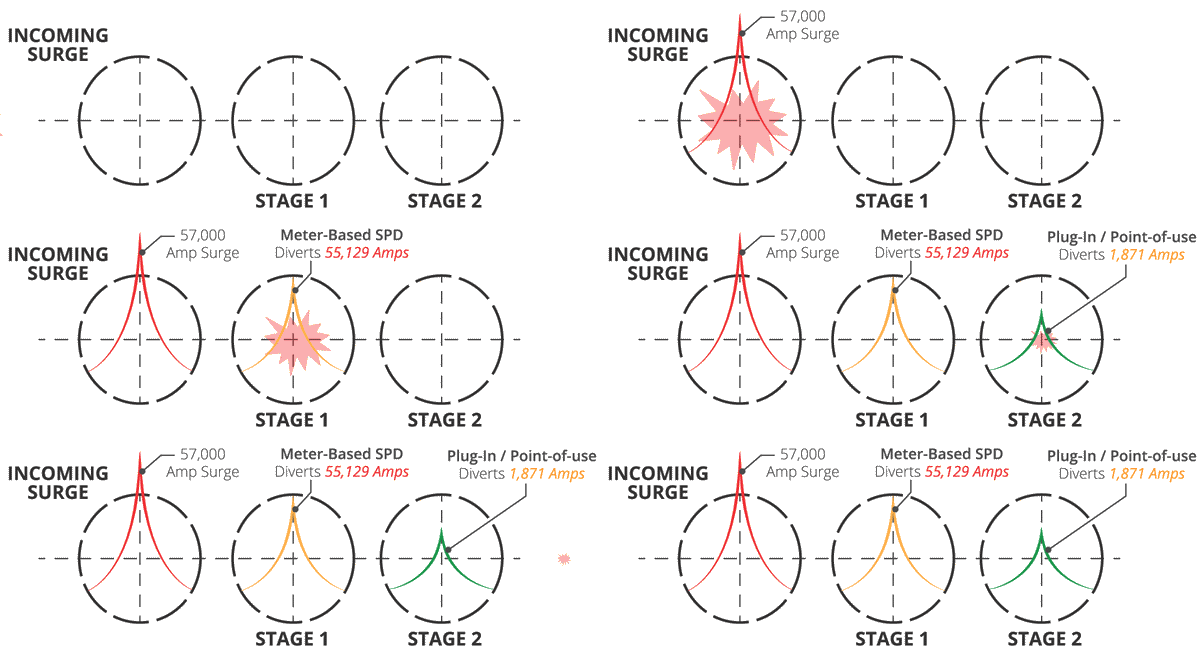
Animation showing an incoming 57,000 Amp surge being reduced by over 95% in Stage 1 (meter-based SPD), enabling the plug-in/point-of-use SPD in Stage 2 to handle the remaining 1,871 Amps more reliably. (The 5Ws of Surge Protection)
Does a UPS count as a surge protection device?
Sometimes, though it isn’t their primary function. A UPS, or uninterrupted power supply, is often referred to as simply “battery backup” and are built to keep equipment running through power interruption; that’s a battery runtime feature, separate from surge suppression. Many UPS units add a surge-suppression stage, but that stage is no more resistant to being overwhelmed than a standard surge-protected power strip. A UPS without a surge-rated stage provides backup power and nothing else.
Checking the specifications is the only reliable way to know which kind is in use. Runtime and surge protection are usually listed separately, and a unit can offer strong battery backup with weak or no surge protection at all.
To avoid the potential damage of unexpected power loss and residual surge energy, it is recommended to get a UPS battery backup with surge protection for your most sensitive equipment. To reiterate, though, the surge protection function of these units does not replace the function of a Type 1 meter-based or panel-mounted surge protection device.

Whole-building protection
Is a meter-based SPD better than a hardwired panel-mounted alternative?
Both provide Type 1 protection when installed at the service entrance. The difference in SPD "Types" is installation location, and the choice between them comes down to what a given utility allows and where the equipment needs to sit.
Meter-based:
400 Series, 575 Series, 575-CEB, 675-3PAL, and CL320 Series SPDs. These install directly into the meter socket, ahead of the distribution or breaker panel, with no panel work required. Utilities may offer these units as part of their Utility Surge Program, maintained directly by the electrical service provider.
Hardwired panel-mount:
RCHW Series and MAP Series. These install at or near the distribution panel and carry a dual Type 1/Type 2 rating depending on where they land. Higher-capacity specifications found in these and other series are typically used in commercial and industrial facilities, but residential application versions are offered as direct protection of HVAC, deep well and pool pumps, in addition to service entrance surge protection.
Utilities frequently restrict modifications at the meter socket entirely. When that’s the case, a panel-mounted device becomes the only practical option, however the level of protection is comparable.
You can view the specs and details, including surge current ratings (kA), voltage protection ratings (VPR), nominal discharge current (In) and UL testing performance, for all of these models side-by-side on the Compare Meter-Based Surge Protectors page.
Additional entry points
What about surges coming through the cable, phone, or network lines?

Power lines are one entry point, not the only one. Telephone, cable, satellite, and network cabling can each carry surge energy directly to connected equipment, independent of whatever protection exists on the electrical service.
Damage through these pathways happens even when a meter-based SPD is installed and functioning correctly, because that device was never positioned to intercept a surge arriving through a phone or cable line. Protecting each pathway takes a device built for it.
-
SLT Series – data and signal lines
-
SLT CAT6 POE – ethernet, including Power over Ethernet
-
CLT Series – coaxial (cable/satellite) line
-
TLT Series – telephone lines
It is important to note that many Type 3 surge-protected power strips and UPS battery backups include integrated data ports (like CAT/LAN and Coaxial), but not all of these are surge protected. A Type 3 SPD certification only refers to protecting the electrical power connection of the device at the point-of-use. If the integrated port only has terms like “noise” or “isolation”, it may not be surge protected. Always look for a data line protection specification that specifically mentions clamping voltage or max surge current (kA) – independently certified under the UL 497 standard. These distinct metrics indicate that the integrated ports offer true data-line surge protection. Dedicated point-of-use SPDs with UL 497 certification, like the SLT Series, are engineered to handle high-speed data transmission (like CAT6) without throttling your internet speed, a common issue found with basic pass-through ports on cheaper integrated power strips.
Water lines can carry surge energy under some conditions, though this is uncommon enough that it’s rarely a primary concern.
A direct or very close lightning strike falls outside this. The energy involved can exceed what any surge protection device is built to withstand, at any point in the system. The pathways above cover the transient energies that happen regularly from induced surges (the invisible EMP of a storm) and distant strikes, never a direct hit.
Warranty coverage
Does my surge protection warranty cover my TV, computer, or other electronics?
Typically not under a meter-based SPD’s warranty on its own. A utility's surge protection program warranty is structured around the electrical service and the major appliances connected to it: HVAC, water heaters, refrigerators, washers, and dryers. Stand-alone electronics, including computers, gaming systems, and similar smart devices, generally fall outside of that specific coverage regardless of how the damage occurred. Coverage can also be affected by where the surge entered – surge through an unprotected pathway, damage unrelated to a surge, or damage from a direct lightning strike are usually excluded as well.
A meter-based SPD and any point-of-use devices installed cover the different equipment under different terms. Coverage for a computer or television comes from whatever warranty applies to the Type 3 device protecting it, not from the meter-based unit’s warranty.
Full coverage terms are listed on the FAQ page and in your utility’s Surge Protection Program documentation.
Next?
Every property differs in service voltage, panel location, and what’s plugged in where. The SPD Selection Guide in the Knowledge Base gives recommendation based on a specific system’s inputs. If you already know you’re looking at meter-based or panel-mounted options, the Type 1 Product Comparison lets you compare products side-by-side and better understand the specifications behind them. It covers standards and compliance considerations such as ANSI/UL 1449, UL 414, NEMA, and NEC requirements, and defines important terms like In (nominal discharge current), SCCR (Short Circuit Current Rating), and MCOV (Maximum Continuous Operating Voltage). It also explains the difference between single-phase and three-phase protection and covers Class 320 meter-based SPD, including how maximum load rating can affect service derating (PDF).
If you would like to expand your understanding of surge protection in a structured way, we offer a free Surge Protection Basics: Surge 101 course for both residents (utility end-users) and a more comprehensive version for professionals in commercial applications. These free courses will guide you through many of the same topics covered here, expanded with key terms and quizzes.
We added surge protection devices for solar power applications to our catalog, which is covered in the Solar Integration: Advanced Surge Protection course. You can discover more about how to approach protecting solar power generation systems by visiting the Complete Solar Surge Protection page, featuring interactive maps of key protection points for the entire solar string with recommended products for both DC and AC Power.


Online Training
Complete training courses designed for electrical professionals and residential utility customers


